Patience as Craft: The Precise Art of Capturing Wild Animals in Their Most Authentic Moments
There is a particular kind of silence that precedes a great wildlife photograph. It is not the silence of an empty room or a paused recording — it is the concentrated, almost physical stillness of a person who has learned to disappear. Paul Nicklen has inhabited that silence for decades, crouching in Arctic snow, submerged beneath polar ice, or pressed flat against volcanic rock, waiting for the precise convergence of light, behavior, and instinct that produces an image capable of stopping a viewer mid-breath.
For collectors and art enthusiasts who encounter Nicklen's work at paulnicklengallery.com, the surface impression is one of breathtaking beauty. Look longer, and something more complex begins to emerge — the evidence of a process so demanding in its physical and psychological requirements that the resulting photographs can only be described as hard-won. Understanding that process does not merely enrich the viewing experience; it fundamentally reframes what it means to own one of these works.
The Anatomy of a Wildlife Moment
Wild animals do not perform on cue. They do not repeat behaviors for a photographer who missed the shot the first time, and they extend no courtesy to human schedules or equipment malfunctions. What they offer, occasionally and without warning, are moments of such unguarded authenticity that the camera, if positioned correctly and operated with sufficient skill, can preserve them indefinitely.
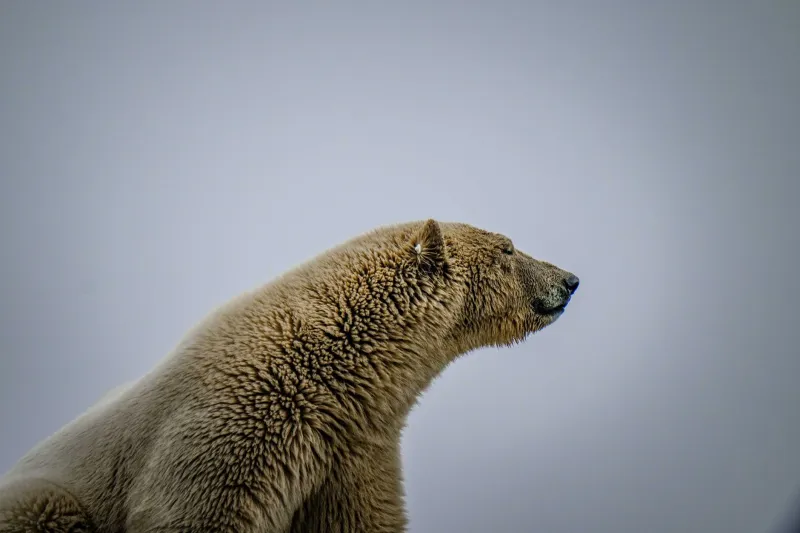
Nicklen has described his methodology not as photography in the conventional sense but as a form of behavioral immersion. Before he raises his camera, he studies. He observes feeding patterns, social hierarchies, seasonal rhythms, and the subtle body-language signals that telegraph an animal's next move. In the Arctic — the landscape that has defined much of his career — this preparation takes on life-or-death stakes. Reading a polar bear's posture incorrectly is not an aesthetic failure; it is a physical danger.
This depth of preparation is precisely what separates Nicklen's images from those produced by photographers who rely on proximity alone. His compositions are not the result of simply being close to a wild animal. They are the result of understanding, with near-scientific precision, what that animal is about to do.
Timing Beyond the Technical
In photography education, timing is often discussed in purely mechanical terms — shutter speed, burst rate, the fraction-of-a-second delay between the photographer's intention and the camera's response. These factors matter, and Nicklen commands them with the fluency of someone who has spent entire careers in the field. But in his practice, technical timing is merely the instrument. The more consequential skill is anticipatory timing: the ability to recognize, before it fully manifests, the behavior that will define the image.
Consider the challenge of photographing a leopard seal in open water beneath Antarctic ice. The animal is among the ocean's most powerful predators, capable of sudden, explosive movement. A photographer waiting to react will always be late. Nicklen's approach inverts this dynamic entirely — he positions himself not where the animal is, but where the animal's behavior suggests it will be. The camera is ready before the moment arrives. When it does, the response is almost reflexive.
This anticipatory discipline is something collectors frequently sense without being able to articulate. There is a quality of inevitability in Nicklen's strongest images — a sense that the frame could not have been composed any other way, that the animal and the light and the environment conspired to produce exactly this arrangement. That quality is not accidental. It is the residue of years spent learning to think like the subjects he photographs.
The Psychology of Presence
One of the most counterintuitive aspects of Nicklen's field practice is his deliberate minimization of human urgency. Wild animals are exquisitely sensitive to the behavioral cues of other species, and the anxious, goal-oriented energy that characterizes most human activity is precisely the signal that causes subjects to flee or become defensive. Nicklen has written and spoken about the necessity of arriving in an animal's presence without agenda — of being, in some meaningful sense, simply another element of the environment.
This is easier to describe than to achieve. It requires suppressing the photographer's natural instinct to capture, to frame, to act. It demands a quality of presence that is closer to meditation than to sport. And it takes years to develop, because it is not a technique that can be learned in a classroom or replicated through equipment upgrades. It is, at its core, a form of character — a cultivated capacity for surrender that paradoxically produces images of extraordinary power.
For American collectors accustomed to evaluating art through the lens of technical achievement or conceptual sophistication, this psychological dimension of Nicklen's practice offers a third axis of appreciation. The prints that hang in living rooms and private galleries across the country are not merely beautiful objects. They are evidence of a particular kind of human discipline — one that is increasingly rare in a culture that prizes speed and efficiency above all else.
What Stillness Looks Like on a Wall
When a Nicklen print is acquired and installed in a home or office, it brings with it the full weight of the process that produced it. A humpback whale ascending through blue-black water carries the memory of the hours Nicklen spent in that water before the ascent occurred. A wolf pausing at the edge of a frozen lake contains within it the accumulated patience of a photographer who understood that the pause would come, and who was ready when it did.
This is what distinguishes wildlife art photography from wildlife documentation at its most functional. Documentation records what happened. Art — at the level Nicklen consistently achieves — records what it meant to be present when it happened. The collector who hangs one of these prints is not acquiring a representation of a wild animal. They are acquiring a distillation of encounter: the product of two organisms, one human and one not, briefly sharing the same moment in the same wilderness.
The most discerning collectors understand this intuitively. They are drawn not just to the visual beauty of the image but to its density — the sense that there is more information in the frame than can be absorbed in a single viewing. That density is real. It is the accumulated weight of preparation, patience, and the irreplaceable instinct that tells a photographer, in the fraction of a second before everything changes, that now is the time.
A Living Archive of Behavior
Nicklen's body of work, considered as a whole, constitutes something remarkable: a living archive of wild animal behavior documented with both scientific rigor and artistic intention. As the ecosystems he has spent his career photographing face accelerating environmental pressures, the behavioral authenticity captured in each frame takes on additional significance. These are not reconstructions or approximations. They are records of how animals moved, interacted, and existed in habitats that are themselves changing beyond recognition.
For the collector, this adds a dimension of cultural and historical weight that few other art forms can claim. To own a Paul Nicklen print is to hold a piece of a world that is actively in flux — a moment of stillness extracted from a wilderness that never truly stops moving. That is the quiet miracle at the center of his practice, and it is the reason that understanding his process transforms not just how you see his work, but how you feel about what it means to preserve it.