Eye to Eye: The Philosophy of Mutual Recognition in Paul Nicklen's Arctic Wildlife Portraits
There is a particular moment that experienced collectors of Paul Nicklen's work often describe when first encountering one of his close-range Arctic portraits. It is not the technical brilliance they notice first, nor the extraordinary light that refracts through polar water or dances across sea ice. What stops them — sometimes literally mid-step in a gallery — is the unmistakable sensation of being regarded. Of being seen.
This is the quiet revolution at the heart of Nicklen's most intimate wildlife portraiture. Where conventional nature photography has long positioned the animal as spectacle — a subject to be observed from a respectful, even clinical, distance — Nicklen collapses that distance entirely. His camera does not merely document; it enters into something that feels, to the viewer, uncomfortably close to a conversation.
The Architecture of Intimacy
To understand what distinguishes Nicklen's close-up wildlife portraits from the broader canon of nature photography, it helps to consider the formal choices that define them. His approach to framing is not accidental. Working in conditions that would deter most photographers — submerged in near-freezing Arctic waters, lying motionless on shifting sea ice — Nicklen positions himself at eye level with his subjects. This single compositional decision carries enormous philosophical weight.
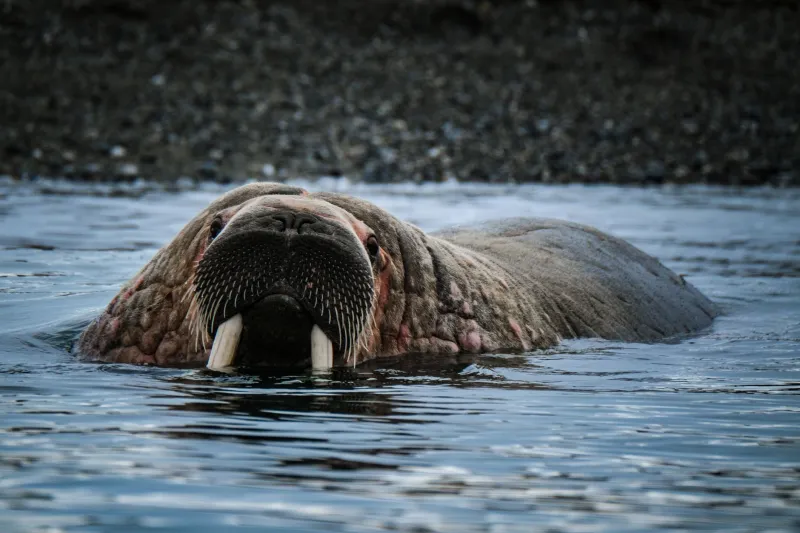
Eye-level framing, as any portraitist working in the human tradition will confirm, is an act of equivalence. It refuses hierarchy. When Nicklen photographs a walrus at close range, filling the frame with the animal's barnacled face and dark, liquid eyes, he is not presenting the creature as something exotic or other. He is presenting it as a presence — an entity with interiority, with something that functions, at minimum, as a point of view.
The result is a body of work that sits in fascinating tension with the landscape photography tradition. Where the sweeping panorama places the human viewer in a position of sublime overview — master of all they survey — Nicklen's portraits strip that distance away. The animal is not backdrop. It is protagonist.
What the Walrus Knows
Among Nicklen's most discussed Arctic portraits are his images of Pacific walruses, captured during expeditions to the waters of the Bering and Chukchi Seas. These are animals that do not, by any conventional aesthetic standard, invite the kind of viewer empathy more readily extended to charismatic megafauna like polar bears or wolves. Walruses are massive, ungainly, scarred by time and competition. Their faces are remarkable precisely because they are so thoroughly particular — creased and whiskered and ancient-looking in a way that resists easy idealization.
And yet, when Nicklen brings his lens to within feet of a resting walrus and captures the animal's gaze in full resolution, something extraordinary happens. Collectors and gallery visitors consistently report an experience of recognition — not identification exactly, but something adjacent to it. The animal appears, in those images, to be engaged in its own act of appraisal.
This is not anthropomorphism in the sentimental sense. Nicklen has spoken at length about his deep grounding in marine biology, and his understanding of animal cognition informs how he approaches his subjects. What his portraits communicate is not that walruses think like humans, but that they think — that they perceive, that they respond, that they occupy their world with a fullness that the camera, in his hands, is capable of honoring.
The Collector's Relationship to 'Personhood'
For American collectors navigating the contemporary fine art market, the appeal of Nicklen's wildlife portraits operates on several levels simultaneously. There is, of course, the undeniable visual impact — the technical mastery, the extraordinary access to environments and animals that most viewers will never encounter firsthand. But collectors who have invested in Nicklen's close-range Arctic portraiture often articulate something more specific when asked what drew them to a particular work.
Many describe what might be called the personhood quality of the image — the sense that the animal depicted possesses a life that extends beyond the frame, before and after the shutter clicked. This quality is not incidental to the work's value as a collectible; it is, increasingly, central to it.
The art market has witnessed a meaningful shift over the past decade in how sophisticated collectors approach wildlife and nature-based work. Where earlier generations might have prized dramatic action shots — the predator mid-strike, the herd in full flight — contemporary collectors show a marked preference for work that asks quieter, more philosophically demanding questions. Nicklen's intimate portraits sit squarely within this evolving sensibility. They do not offer easy awe. They offer something more durable: a sustained encounter with another form of consciousness.
Challenging the Landscape Tradition
It is worth situating Nicklen's portraiture within the broader history of wilderness photography in America, a tradition that runs from the majestic Yosemite imagery of Ansel Adams through the wildlife documentation of the mid-twentieth century and into the digital age. That tradition has been, in the main, a tradition of distance — the photographer as witness to grandeur, preserving the sublime for those who cannot access it themselves.
Nicklen's close-range Arctic portraits represent a genuine departure from this paradigm. By eliminating the comfortable remove between viewer and subject, he asks collectors and gallery visitors to reconsider the terms of their relationship to the natural world. The wilderness, in his portraiture, is not a backdrop for human contemplation. It is a place populated by specific individuals — this walrus, this leopard seal, this narwhal — whose particularity demands acknowledgment.
This is, at its core, a political as well as an aesthetic act. Nicklen has been transparent about his belief that emotional connection precedes conservation commitment — that people protect what they feel bound to, and that art can forge those bonds more effectively than data alone. His portraits are, in this reading, instruments of moral reorientation as much as objects of aesthetic pleasure.
Acquiring a Gaze
For collectors considering adding Nicklen's Arctic portrait work to their holdings, it is worth reflecting on what it means to live with an image that looks back at you. These are not works that recede into the wall. They participate in the room, in the daily life of the household or the corporate space that houses them. Visitors respond to them. Conversations begin in front of them.
There is a reason that collectors who acquire one Nicklen portrait so frequently return for another. The experience of mutual recognition that his framing technique produces does not diminish with familiarity. If anything, it deepens — the gaze of the animal growing more legible, more specific, more insistent with each passing season.
In a gallery landscape crowded with images designed to impress, Paul Nicklen's intimate Arctic portraits do something rarer and more lasting. They compel. They require a response. And in doing so, they remind us that the wilderness was never simply a backdrop to the human story — it has always been conducting its own.