The Arithmetic of Awe: What It Truly Costs to Create a Paul Nicklen Photograph
There is a moment in every Paul Nicklen photograph that appears effortless. A leopard seal rising through a cathedral of Antarctic blue. A polar bear suspended in the last light of an Arctic evening. A humpback whale pivoting through bioluminescent water as though performing for no one in particular. These moments feel spontaneous, as though the world simply offered itself and Nicklen was there to receive it.
What that stillness conceals is staggering.
Before a single shutter click, before the image that will eventually grace the wall of a collector's home in Manhattan or Marin County, there are months of logistics, tens of thousands of dollars in expedition costs, and a physical commitment that most people would consider unthinkable. Understanding what goes into producing a Paul Nicklen photograph does not diminish its beauty. It deepens it—and it clarifies, with remarkable precision, why his prints command the prices they do.
The Expedition Economy
Polar and remote wilderness photography is among the most expensive disciplines in the visual arts. A single expedition to the High Arctic or the Antarctic Peninsula can cost anywhere from $80,000 to well over $200,000 when all variables are accounted for. Those variables are numerous and unforgiving.
Arctic and Antarctic travel typically requires charter vessels capable of navigating pack ice—vessels that are not rented by the hour. Icebreaker charters run into the tens of thousands of dollars per week. Permits to photograph in protected polar regions, many of which fall under international environmental treaties, require extensive documentation, advance planning, and fees that vary by jurisdiction and season. In some of the most sensitive ecosystems Nicklen works within, permits are limited by quota and are granted to only a handful of photographers and researchers annually.
Equipment costs compound the figure substantially. Nicklen shoots with underwater housings engineered specifically for sub-zero temperatures, where standard seals fail and electronics behave unpredictably. His camera systems are maintained, calibrated, and often replaced between expeditions. Dive equipment rated for polar water—drysuits, regulators, redundant buoyancy systems—must be in perfect working order. A single equipment failure at depth in 28-degree Fahrenheit water is not an inconvenience. It is a life-threatening emergency.
Safety teams, guides, and field support personnel round out the budget. In remote locations with no evacuation infrastructure, Nicklen often travels with experienced polar guides, medical personnel, and satellite communication systems. These are not luxuries. They are the operational baseline for working in places where help is measured in days, not minutes.
Months of Waiting, Seconds of Image
The economic investment only tells part of the story. The temporal one is equally extraordinary.
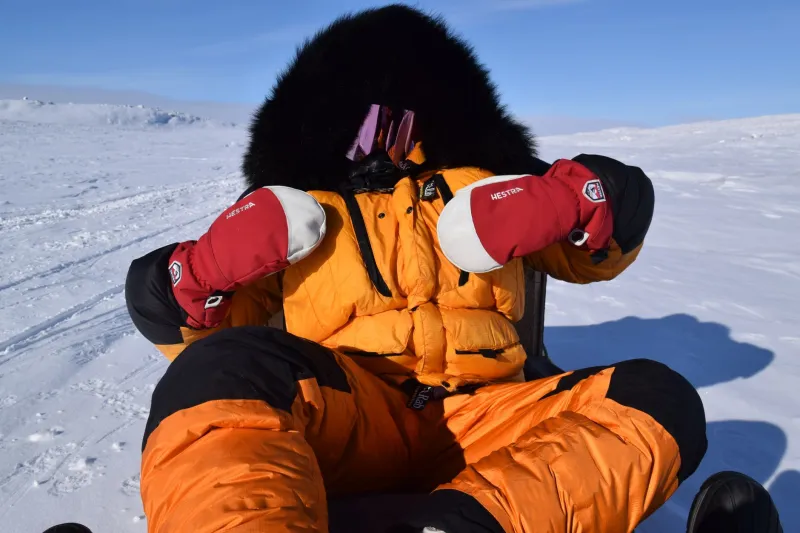
Nicklen has spent as many as three to four weeks on a single ice floe waiting for conditions to align—specific light, specific animal behavior, specific atmospheric clarity. He has returned to the same location across multiple seasons, sometimes over the course of years, before the precise convergence of elements he envisioned finally materialized. The photograph that a collector holds in their hands may represent the culmination of five years of repeated effort in a single location.
This patience is not passive. It is a form of artistic discipline that has no direct parallel in studio-based visual art. A painter can revisit a canvas. A sculptor can rework a form. A wilderness photographer working in extreme environments must be present at the exact moment the world cooperates—and that moment, when it comes, may last four seconds.
The ratio of time invested to time captured is perhaps the most striking arithmetic in Nicklen's practice. Months of preparation, travel, waiting, and survival distilled into an instant.
Rarity as Documentation
For collectors, this calculus has direct implications for value—both financial and cultural.
The rarity of a Paul Nicklen print is not manufactured through artificial edition limits alone, though his prints are indeed released in carefully controlled editions. The rarity is baked into the image itself. The places Nicklen photographs are among the least-visited on the planet. The animals he documents are often endangered, their populations declining in measurable increments each decade. The ice formations, glacial faces, and underwater seascapes that appear in his work are, in many cases, no longer intact. Some of the environments he has photographed over the past three decades have undergone irreversible transformation.
Owning a Nicklen print means owning documentation of a world that required extraordinary sacrifice to access and that may not be accessible—or even exist in its current form—in the years ahead. That is not a marketing claim. It is a geological and ecological fact.
The Ethics of Access
There is a dimension to the cost of Nicklen's work that resists financial quantification: the ethical weight of the access itself.
Nicklen has spoken at length about the responsibility he feels when entering fragile ecosystems. His expeditions are designed to minimize impact—small teams, non-motorized approaches where possible, careful attention to animal behavior and stress signals. The permits he operates under are not merely bureaucratic requirements. They are part of a framework he genuinely believes in.
This ethical orientation extends to how his images are used and what they advocate. Nicklen's work has been presented before the United Nations, used in environmental litigation, and cited in conservation policy discussions. The photographs are not decorative objects that happen to depict nature. They are arguments—made with extraordinary beauty—for the preservation of the places that made them possible.
For collectors who are drawn to work that carries meaning beyond aesthetics, this context is not incidental. It is central to the value proposition.
What the Price Reflects
When a collector acquires a Paul Nicklen fine art print, the price on the invoice represents a fraction of what the image actually cost to produce. The remainder was paid in fuel and charter fees, in permit applications and safety equipment, in weeks of cold and discomfort and uncertainty, and in the kind of focused artistic patience that cannot be purchased at any price.
What the collector receives in return is something proportionally rare: an image made in a place most people will never see, of a subject that may not survive the century, by an artist who spent everything required to be there.
That is not an expense. It is an investment—in craft, in documentation, and in the enduring power of wilderness made visible.