A Witness in Ice: How Paul Nicklen's Polar Archive Is Rewriting the Visual Language of Climate Reckoning
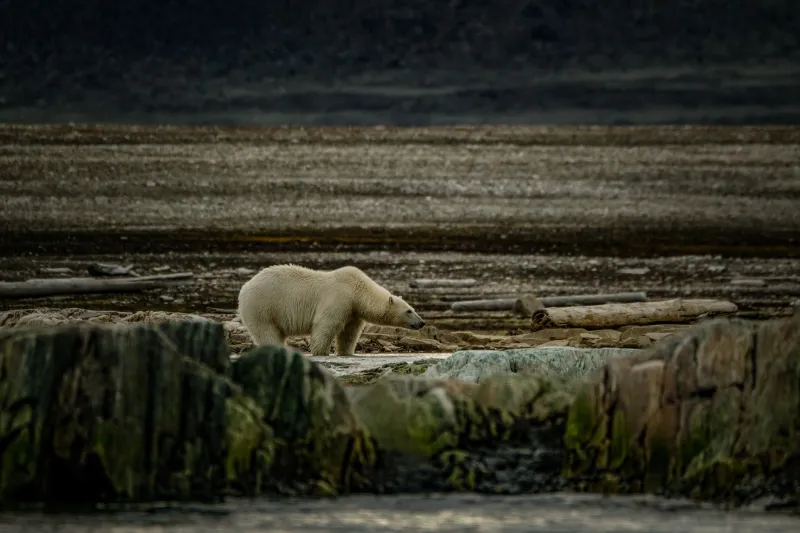
There is a particular image — a polar bear suspended at the edge of fractured sea ice, the Arctic horizon bleeding violet and gold behind him — that stops visitors cold in the gallery. Not because it is merely beautiful, though it is undeniably that, but because it feels like a document. A confession. A record of something the world is losing faster than most of us are prepared to acknowledge.
This is the quiet power at the center of Paul Nicklen's archive: the capacity to render environmental transformation not as data, not as alarm, but as something felt in the chest.
For collectors and cultural institutions across the United States, that distinction has become increasingly significant. In an era saturated with climate statistics and policy debates, Nicklen's photographs occupy a rare space where aesthetic mastery and scientific urgency converge — producing works that function simultaneously as fine art, historical record, and emotional argument.
Decades in the Field, a Generation in the Archive
Nicklen's relationship with the polar regions stretches back more than three decades. Raised in a remote Inuit community on Baffin Island in Canada, he developed an intimacy with Arctic ecosystems that most wildlife photographers never attain. That closeness — cultural, ecological, and deeply personal — informs every frame he has ever captured.
What has accumulated over those decades is extraordinary in scope. His archive spans the high Arctic and Antarctic, documenting species, landscapes, and ice formations that, in many cases, no longer exist in the forms he photographed. Glaciers have retreated. Ice shelves have collapsed. Species ranges have shifted. The photographs Nicklen made twenty years ago in places that have since transformed dramatically are not merely art historical artifacts — they are baseline measurements, visual benchmarks against which the present can be compared.
This dual nature — artistic and evidentiary — is what makes his archive so compelling to a growing audience of American collectors who understand that what they are acquiring is not simply a print, but a piece of the planet's autobiography.
Art as Climate Testimony
The traditional mechanisms of climate communication — scientific papers, government reports, news cycles — have struggled for decades to translate data into sustained public engagement. Statistics, however alarming, rarely move people to act or to care in the sustained, embodied way that genuine emotional experience does.
Art, at its most potent, bypasses the analytical mind entirely.
A Nicklen photograph of a leopard seal rising from the Antarctic waters does not require explanation. It does not demand that the viewer understand parts per million of atmospheric carbon or the intricacies of ocean acidification. It asks only that the viewer be present — and in that presence, something shifts. The animal becomes real. The ecosystem becomes precious. The threat becomes personal.
Museums and educational institutions across the country have begun to recognize this capacity. Universities with environmental programs, natural history museums, and conservation-focused nonprofits have integrated large-format Nicklen prints into their permanent collections and traveling exhibitions, not simply as decorative acquisitions but as pedagogical tools. The photographs do what no textbook illustration can: they place the viewer inside the experience of wilderness, and in doing so, they create a form of empathy that outlasts any lecture.
The Collector's Role in a Larger Story
For private collectors in the United States, acquiring a work from Nicklen's archive carries a meaning that extends well beyond aesthetic preference or financial strategy — though both remain legitimate and compelling considerations.
The investment case for Nicklen's work is, by now, well established. Limited-edition prints from an artist of his stature and international recognition tend to appreciate steadily, particularly as the cultural conversation around environmental art continues to intensify. But what distinguishes Nicklen's collectors from those who simply acquire wildlife photography is, increasingly, an understanding of what they are stewarding.
When a collector in Chicago or San Francisco or New York hangs a Nicklen photograph in their home, they are not decorating a wall. They are making a statement about what they value — what they believe deserves to be witnessed, preserved, and passed on. The photograph becomes a conversation piece in the most literal sense: a prompt for the kinds of discussions that shape how families, guests, and communities think about the natural world.
This is art functioning as advocacy without sacrificing an ounce of its beauty.
The Archive as Living Record
What makes Nicklen's body of work particularly significant from an archival standpoint is its temporal breadth. Unlike a single expedition or a focused project, his decades of continuous engagement with polar environments have produced something closer to a longitudinal study — one conducted through the lens of a camera rather than a scientific instrument, but no less revealing for that.
Researchers and conservationists have increasingly drawn on his imagery to illustrate change over time, comparing landscapes photographed in the 1990s with their present-day counterparts. The results are, in many cases, visually devastating — and visually irrefutable in a way that charts and models rarely achieve.
For collectors, this means that works acquired today carry a historical weight that will only deepen with time. The polar landscapes Nicklen has documented are, in many cases, already altered or imperiled. What he captured — the specific quality of light on a particular ice formation, the behavior of a species in an ecosystem not yet disrupted — may eventually exist nowhere else but in his archive.
To own one of these photographs is, in a very real sense, to hold a piece of a world that is changing faster than any generation before ours has witnessed.
Where Wilderness Becomes Legacy
At Paul Nicklen Gallery, the works presented are chosen not only for their visual power but for their capacity to endure — to mean something in twenty years, in fifty, in a century. The wilderness Nicklen has spent his life documenting is precisely the kind of subject that demands this long view.
As the American cultural conversation around climate continues to evolve, the role of art in shaping that conversation grows more important, not less. Scientific consensus is established. Policy debates continue. But the emotional and aesthetic reckoning — the moment when a culture truly internalizes what is at stake — often comes through art.
Nicklen's archive is already doing that work. In galleries and living rooms, in university corridors and museum halls, his photographs are asking the questions that matter most: What have we inherited? What are we losing? What are we willing to fight for?
The answers, increasingly, begin with a single image — frozen in time, luminous with consequence, and more alive than ever.