Reading the Wild: How Natural Light and Composition Give Paul Nicklen's Photographs Their Narrative Power
There is a particular quality of silence that settles over a viewer standing before a Paul Nicklen photograph. It is not the silence of absence but of compression — the sense that an entire landscape, an entire season, perhaps an entire argument about the natural world, has been folded into a single rectangular frame. That compression does not happen by accident. It is the result of a rigorous and deeply considered visual language, one built from the grammar of light, the syntax of composition, and a philosophical commitment to letting wilderness speak on its own terms.
For collectors and serious enthusiasts, learning to read that language transforms the experience of owning or encountering a Nicklen work. A print that initially registers as beautiful reveals itself, upon closer examination, to be something far more intricate: a precisely constructed argument about place, time, and the relationship between the living world and the forces that shape it.
Light as the Primary Subject
In most photographic traditions, light is understood as a tool — something that illuminates a subject. In Nicklen's work, the relationship is frequently inverted. Light becomes the subject itself, and the animal, the glacier, or the wave becomes the vehicle through which light declares its character.
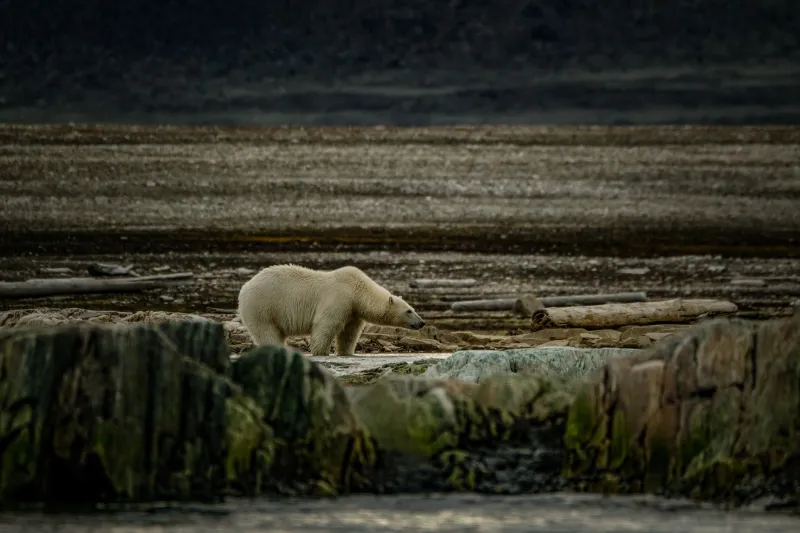
Consider how differently light behaves at the poles. In the Arctic and Antarctic, the sun spends extraordinary stretches of time near the horizon, casting what photographers call "golden hour" illumination not for a few fleeting minutes but for hours at a stretch. This extended low-angle light does something compositionally remarkable: it strips away the harshness of overhead illumination and replaces it with a lateral, raking quality that carves texture from every surface it touches. Sea ice acquires depth and dimensionality. The fur of a polar bear catches fire at its edges. Water, already a complex reflective surface, becomes a kind of moving painting.
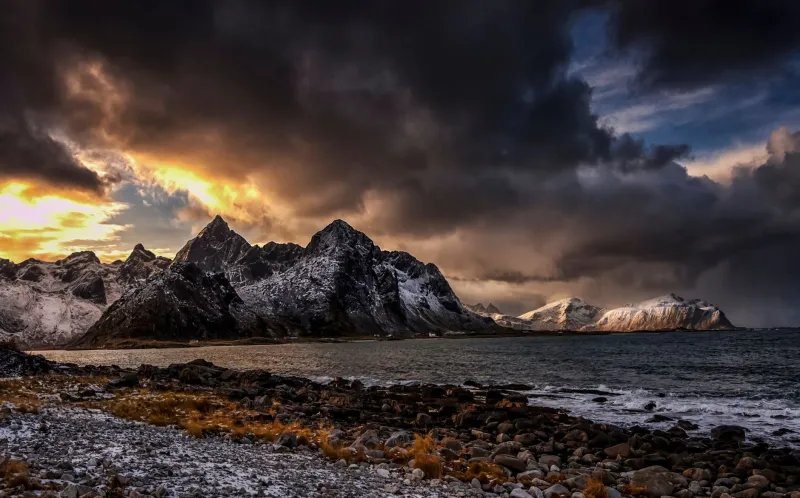
Nicklen has spent decades learning the specific behavior of light in these environments — how it shifts color temperature from the warm amber of early morning to the cold blue of polar dusk, and how those shifts carry emotional weight. Warm light in a frozen landscape creates a productive tension, suggesting fragile vitality against an inhospitable backdrop. Cold, blue-toned light, by contrast, enforces a kind of austere majesty that asks the viewer to reckon with scale and solitude. When collectors respond to a Nicklen piece with the phrase "I don't know why, but it moves me," they are often responding to precisely this tonal intelligence — an emotional register established by color temperature before the rational mind has had time to process the image's content.
Compositional Architecture: Where the Eye Is Led
Beyond light, Nicklen employs a compositional rigor that draws from both classical painting traditions and the more improvisational demands of wildlife photography. The two disciplines are, on the surface, in tension: a landscape painter controls every element; a wildlife photographer must respond to conditions that are indifferent to aesthetic preference. What distinguishes Nicklen's practice is his ability to anticipate compositional opportunities and position himself so that the natural world completes the frame he has already partially constructed in his mind.
His use of leading lines is particularly instructive. In his underwater work, the geometry of kelp forests, ice formations, and ocean swells creates natural pathways that draw the viewer's gaze through the image in a deliberate sequence. The eye enters, travels, and arrives — much as it does when reading a sentence. This sequential experience of a still image is what separates a photograph with narrative depth from one that merely records a moment.
Nicklen also employs negative space with unusual confidence. American audiences, accustomed to images dense with information and activity, sometimes find this restraint initially disorienting. A leopard seal emerging from a vast expanse of dark water occupies perhaps a quarter of the frame. The remaining three-quarters is not emptiness — it is context, atmosphere, and scale. That surrounding space tells the viewer something essential about what it means to be a solitary creature in a boundless ocean, and it does so without a single word of caption.
The Foreground-Background Relationship
One of the most sophisticated elements of Nicklen's compositional vocabulary is his management of the relationship between foreground and background. In landscape photography generally, this relationship establishes depth and invites the viewer into the image. In Nicklen's hands, it does something more specific: it creates a layered argument.
In many of his Arctic images, an immediate foreground element — a fragment of sea ice, a spray of ocean water, a bloom of algae — exists in sharp focus while the middle and far distances dissolve into atmospheric haze or soft light. This technique, borrowed from classical landscape painting, performs a double function. It anchors the viewer in a specific, tactile moment while simultaneously gesturing toward a larger, less certain world beyond. For collectors, this layering is part of what makes a Nicklen print livable over time: there is always another layer to discover, another relationship between near and far to contemplate.
Developing a Collector's Visual Literacy
Understanding these principles equips collectors to engage with Nicklen's work on a more substantive level — and to make acquisition decisions grounded in something deeper than immediate aesthetic pleasure. When evaluating a print, consider the following questions:
Where is the light source, and what is it doing emotionally? Is the light warm or cool, soft or directional? How does its character interact with the subject's mood?
Where does the eye enter the frame, and where does it come to rest? Is there a clear compositional pathway, or does the image ask the eye to wander? Both are valid strategies, but they produce different experiential qualities.
What role does empty space play? In Nicklen's work, restraint is never absence. Negative space carries meaning. Ask what the open areas of an image are communicating about scale, solitude, or the relationship between subject and environment.
How does the foreground relate to the background? Is there a tension or a harmony between near and far? Does that relationship reinforce or complicate the image's emotional argument?
These questions are not technical exercises. They are, rather, a means of entering into a conversation with the image — of treating a photograph as the sophisticated visual statement it is.
Why This Literacy Matters
Paul Nicklen has spoken about his photographs as a form of advocacy, a way of making the abstract urgency of environmental change viscerally immediate. But advocacy, to be effective, must first be art. It must earn the viewer's sustained attention before it can ask for anything in return.
The compositional and lighting principles that structure his work are, ultimately, in service of that goal: to hold a viewer long enough that the wilderness becomes real to them, personal, worth protecting. For collectors who bring these images into their homes, that sustained encounter is the daily gift of ownership. Learning to read the grammar of Nicklen's photographs does not diminish their emotional power. It deepens it — transforming what might have been a beautiful object into something closer to a living conversation between wilderness and the people willing to look.